
GOVERNANCE AND THE BARAKA OF JUSTICE - When Algorithmic Prediction Becomes Structural Exclusion
Abstract. Predictive AI — the systems that score, flag, and allocate — has become financial infrastructure without the governance architecture such infrastructure requires. Where the third paper in this series treated AI as a source of authoritative guidance, this paper treats AI as an instrument of allocation: the credit models, identity systems, and risk classifiers that determine who participates in financial markets and who is structurally excluded. When the prediction is built on biased inputs and granted institutional weight, the system shapes the realities institutions produce — in markets the maqāṣid require to operate justly. The governance architecture for this problem already exists in fragments across AAOIFI and IFSB standards. What does not yet exist is the institutional decision to apply that architecture to the source code rather than only to the spreadsheet.
When prediction writes reality, the model is not describing the future. It is deciding it.
I. The Veiled Command
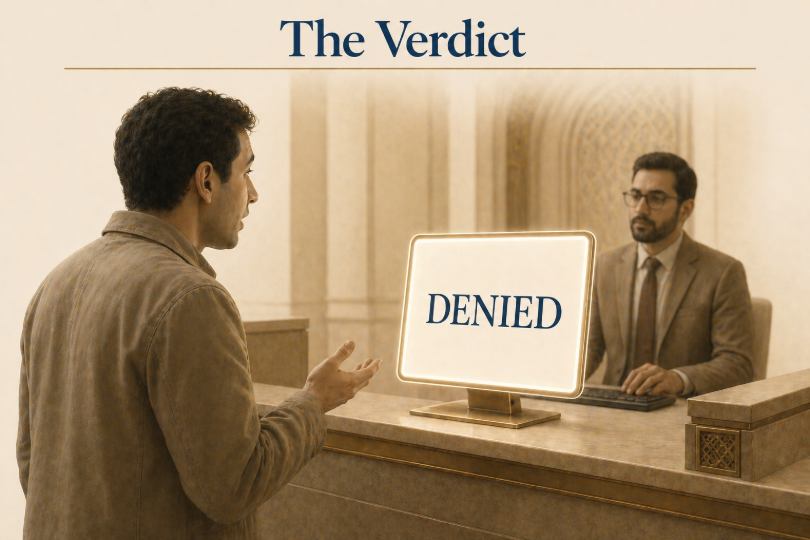
Carissa Véliz’s TED 2026 lecture, Beware the Power of Prediction, makes a claim that bears directly on financial institutions deploying predictive AI. AI predictions, the Oxford philosopher argues, do not merely describe futures. They shape them. When an algorithm deems a person a poor credit risk, that prediction is not an estimate institutions then weigh against other evidence. It functions as a verdict. The loan is denied. The opportunity is foreclosed. Véliz calls this a veiled command — a system output presented as analysis that operates as instruction.
The mechanism is self-validating. A model trained on past lending patterns learns that certain communities were rarely lent to. The model concludes, accurately, that lending to them was uncommon. Institutions deploying the model lend to those communities less. The next round of training data shows even more pronounced exclusion. The pattern compounds.
The prediction did not describe the future. It enforced the past.
The third paper in this series [View] established that AI must not be permitted to occupy the structural role of a Sharī‘ah determination without the governance architecture that role requires. The same principle applies to a different AI function. When predictive AI occupies the structural role of an allocator — deciding who receives capital and on what terms — it must be governed by the standards Islamic finance applies to every other allocator of capital.
The first paper in this series [View] documented what governance failure produces in Islamic finance: tighter spreads, capital flight, and reputational damage that does not respond to financial remedies. The mechanism extends. A predictive system that systematically excludes populations from financial participation, deployed without governance review, exposes the institution to the same class of risk — measured this time in regulatory action and the long-run erosion of trust that maqāṣid-aligned finance requires.
A model trained on yesterday’s exclusions does not predict tomorrow. It enforces yesterday.
II. From Probabilities to Predestination
Islamic theology has a precise vocabulary for the line predictive AI risks crossing. Qadar — divine decree — is the name the tradition gives to what is ordained beyond human authorship. Kasb — acquisition through human action — names what is genuinely earned through choice, effort, and circumstance. The tradition has reasoned carefully about where the line between them sits, and how human agency operates within the larger structure of decree.
Probability is a third category. It is neither qadar nor kasb. It is an inferential estimate, generated from observed patterns, about what is likely to occur. In statistical terms, this is a useful and well-understood category. In theological terms, it has no claim to the authority of decree. To treat a probabilistic model output as if it were qadar — as if the prediction carried the weight of destiny rather than the weight of estimate — is a category error with material consequences.
Algorithmic qadar is the name for that error. The term is used critically — to name the institutional weight granted to probabilistic estimate, not to analogize machine inference to divine decree. The tradition admits no such analogy. The point is precisely that institutions treating prediction as if it carried that weight are operating on the error the term names.
The error is theological, but its consequences are operational.
Cathy O’Neil’s Weapons of Math Destruction documented how credit-scoring models trained on historical lending data propagate past discrimination forward as analytical risk assessment. Virginia Eubanks’s Automating Inequality documented the same dynamic in welfare allocation and digital identity systems — populations without standardized documentation pushed further into administrative invisibility by the systems meant to serve them. Buolamwini and Gebru’s Gender Shades established a methodology for measuring algorithmic bias across demographic populations and documented systematic disparities in commercial AI systems.
In Islamic finance contexts, the affected populations include Muslim micro-entrepreneurs in markets where conventional credit history is sparse, refugees and migrants without standard documentation, and women in jurisdictions where access to banking has been institutionally constrained. These are precisely the populations the maqāṣid most explicitly require Islamic finance to serve.
The first paper in this series established that ungoverned systems produce measurable harm in Islamic finance. The second paper [View] established that what is not taught in the curriculum cannot be governed in practice. Predictive AI is currently both: ungoverned by Sharī‘ah oversight in most institutional contexts, and untaught in the curriculum that produces the next generation of Sharī‘ah board members. The result is an institutional capacity gap precisely where predictive AI is scaling fastest.
To conflate what is probable with what is ordained is to mistake machine inference for divine intent. Islamic finance has no doctrine that permits this confusion.

III. Predictive Exclusion: When Exclusion Becomes Structural
Zulm — injustice, oppression, the placing of something where it does not belong — is among the most consequential categories in Islamic ethics. The Qur’an names zulm as the condition God most explicitly forbids. But not every algorithmic disparity rises to the threshold the term names. The tradition reserves zulm for injustice that is systematic, material, and unremediated. Where exclusion meets that threshold — distributed across institutions, measurable in outcome, and uncorrected by the systems producing it — the theological category applies. The remainder of this section uses predictive exclusion as the analytic term for what the tradition names theologically. The threshold is what determines whether the theological category attaches.
The pattern manifests in three concrete domains, each documented in the predictive-AI scholarship cited in the prior section.
Credit scoring trained on past lending data reproduces historical exclusion at scale. A model trained on a dataset in which Muslim micro-entrepreneurs were rarely approved learns, accurately, that approval was rare — and propagates the pattern forward as risk assessment. The exclusion is presented as objective. The objectivity is illusory. What the model learned is the historical pattern of who was lent to. What the institution treats it as is a prediction of who should be lent to. The conflation is the harm.
Digital identity systems that disadvantage applicants without conventional documentation function as infrastructural gatekeeping. The populations most affected — refugees, migrants, the unbanked, communities operating in cash economies — are disproportionately Muslim in many of the markets where Islamic finance is positioned to grow. A system that demands documentation patterns it was never designed to recognize is not neutral. It is a structural exclusion mechanism dressed in administrative language.
Behavioral risk flags aggregated across institutions create the compounding pattern that distinguishes predictive exclusion from individual institutional discretion. A flag generated at one institution becomes input data at another. That institution’s model treats the flag as signal. Its output flags the same applicant more aggressively. The institution down the chain inherits an applicant whose risk profile has been constructed by institutional history rather than personal record. No single institution can be held accountable for the cumulative outcome, because no single institution produced it. The accountability is distributed; the harm is concentrated.
The pattern has a structural feature traditional governance does not yet address. The exclusion is real, the responsibility is diffuse, and the populations harmed are those the tradition most explicitly obligates Islamic finance to serve. The third paper in this series argued that governance architecture must be built into the systems institutions rely on. The same argument applies here, with a sharper edge. In the third paper, the failure mode was misattributed authority. In this paper, the failure mode is distributed harm. Both require the same response: structural Sharī‘ah oversight of the systems themselves, not only of the institutions deploying them.
When exclusion is produced by a model, distributed across institutions, and presented as analytical neutrality, the absence of a single accountable party does not absolve the system. It indicts the governance architecture that permits the system to operate.
IV. From Spreadsheet Audit to Source Code Audit
Three governance instruments meet the threshold this frontier requires. Each operationalizes a standard already written and increasingly formalized by institutions the convening circuit gathers. The architecture exists. The application is what the next phase requires.
AI Sharī‘ah Audits. Annual independent review of models deployed in Islamic finance contexts, examining fairness metrics across vulnerable and adversely affected populations, training-data provenance and stewardship, methodological assumptions, and demonstrated alignment with maqāṣid-aligned outcomes. AAOIFI’s external Sharī‘ah audit standard (ASIFI 6) provides the architectural baseline; IFSB-31’s supervisory framework formalizes the institutional oversight position from which AI audits become legible to regulators. The audit scope, in this application, is source code and training data — not only the spreadsheet outputs the system produces.
Algorithmic Outcome Disclosure. A standardized disclosure framework requiring institutions deploying predictive AI in Sharī‘ah-governed contexts to report measured exclusion rates across vulnerable populations, identified bias remediations, and unaddressed disparities. The model is AAOIFI’s existing Sharī‘ah non-compliance income disclosure norm, extended from financial transactions to algorithmic outcomes. Where exclusion is documented and unremediated, the analog to purification applies — institutional acknowledgment, structural correction, and where appropriate, restitution to affected populations through targeted access programs.
Cross-Disciplinary Ijtihād. The standards-setting work that converts these instruments from concept to enforceable framework requires Sharī‘ah scholars, data scientists, regulators, and maqāṣid specialists working in coordinated review. AAOIFI and IFSB have demonstrated the institutional capacity for cross-disciplinary standard-setting on fintech and digital banking. The same capacity, applied to predictive AI, is what the next phase requires.
This argument builds on the convening leadership already provided by AAOIFI, IFSB, IFN, and the academic conveners whose cumulative work on Islamic finance governance has made this next phase possible. These instruments are operationalizations of the standards those bodies have established — extensions of their work, not corrections of it.
The third paper in this series argued that the digital isnād — disclosed source chains for AI-generated outputs — is the governance architecture for generative AI. Algorithmic outcome disclosure is the parallel for predictive AI. Different output, same structural logic. Both convert the AI system from a black box that produces verdicts into a governed system that produces auditable decisions.
The Sharī‘ah board that audits the spreadsheet but not the source code is governing the symptom while the cause produces the harm at scale.

V. The Baraka of Justice
The Arabic word ʿadl — justice — is among the most foundational categories in Islamic ethics. It is the binding condition under which all transactions, governance arrangements, and institutional relationships in Islamic finance must operate. ʿAdl is not aspirational. It is structural. A system that produces injustice is, by the tradition’s standards, operating outside the conditions under which Islamic finance is permitted to function — regardless of whether the injustice was intended, distributed, or algorithmically generated.
The first paper in this series established that governance quality is what Islamic capital markets price. The second established that governance literacy is what the practitioner pipeline must build. The third established that governance architecture must be embedded in the systems institutions rely on. The fourth established that governance must be auditable in public. This paper adds a fifth dimension: governance must protect the populations the system was built to serve — and the systems that allocate participation must be held to the standards of ʿadl the tradition requires of every other allocator.
Three requirements follow. They are framed not as critique of the institutions deploying predictive AI, but as the work the next phase of Islamic finance governance is ready for.
Independence. Sharī‘ah oversight of predictive AI must be structurally independent of the commercial logic of the institutions deploying the systems. Advisory review by scholars who lack standing to halt deployment is not governance. The institutional intent that oversight is real, not decorative, must be visible in where the oversight function sits. AAOIFI, IFSB, the national Sharī‘ah advisory councils, and the academic conveners are well-placed to anchor this evolution.
Transparency. The methodologies, training data, fairness metrics, and outcome disclosures of predictive AI deployed in Sharī‘ah-governed contexts must be visible — to scholars, to regulators, and where appropriate, to the populations whose participation the systems shape. The discipline of doing this work well — what the tradition names iḥsān, the pursuit of excellence in craft — applies to source code and model documentation no less than to qirā’ah or fiqh. The institutions that lead in this disclosure will set the standard the rest of the industry follows, not through advocacy but through example.
Accountability. Predictive AI deployed in Islamic finance contexts must produce measurably just outcomes — not merely intend them. ʿAdl is the binding requirement, and it is measured at the output, not at the design intent. Documented fairness across populations, public reporting on exclusion rates, and demonstrated remediation when predictive exclusion is identified are the operational form ʿadl takes in algorithmic context. Accountability without measurable outcomes is, as this series has documented from the beginning, symbolic compliance — and symbolic compliance is priced.
These requirements are not aspirational. They are operationally available, and the institutions positioned to build them are the standard-setting bodies, scholarly councils, and governance institutions already engaged with the broader AI governance question.
The disposition the three pillars require has a name in the tradition. Taqwa — God-consciousness — in the institutional context this paper addresses, is the recognition that algorithmic decisions carry the same moral weight as human ones, and the institutional commitment to govern them accordingly. It is what distinguishes an institution that complies with AI governance because it must from one that builds AI governance because the populations the system touches deserve it.
The first paper in this series documented what governed Islamic capital markets produce: tighter spreads, deeper participation, and the long-run credibility that compounds across cycles. The mechanism extends to predictive AI. An institution whose models are auditable, whose outcomes are disclosed, and whose oversight is structurally independent is an institution whose governance becomes a publicly priced asset rather than a privately held one.
An institution whose models are none of these is exposed to a class of risk — regulatory, reputational, and maqāṣid-grounded — that the tradition’s standards have long addressed in principle.
AI deployed without ʿadl will exclude. The march toward digital Sharī‘ah compliance cannot be driven by algorithms alone. It requires institutions behind the systems — governed, transparent, and answerable to the justice the tradition requires.
Authority in Islamic finance is earned by being answerable in public — to scholars, to standards, to capital, and to the communities the system was built to serve. This is the fifth dimension of answerability — and the one the next generation may judge the industry by.
References
• Siddiqui, R. & Hammad, A. Governance and the Baraka of Trust. Baraka Strategic Advisory Council, 2025. [Article 1 in this series]
• Siddiqui, R. & Hammad, A. Governance and the Baraka of Education. Baraka Strategic Advisory Council, 2025. [Article 2 in this series]
• Siddiqui, R. & Hammad, A. Governance and the Baraka of Guidance. Baraka Strategic Advisory Council, 2025. [Article 3 in this series]
• Siddiqui, R. & Hammad, A. Governance and the Baraka of Convening. Baraka Strategic Advisory Council, 2025. [Article 4 in this series]
• Véliz, C. Beware the Power of Prediction. TED 2026, April 2026.
• Véliz, C. Prophecy: Prediction, Power, and the Fight for the Future, from Ancient Oracles to AI. April 2026.
• O’Neil, C. Weapons of Math Destruction: How Big Data Increases Inequality and Threatens Democracy. Crown, 2016.
• Eubanks, V. Automating Inequality: How High-Tech Tools Profile, Police, and Punish the Poor. St. Martin’s Press, 2018.
• Buolamwini, J. & Gebru, T. Gender Shades: Intersectional Accuracy Disparities in Commercial Gender Classification. Proceedings of Machine Learning Research, 81, 2018.
• Accounting and Auditing Organization for Islamic Financial Institutions. Governance Standards, including GS 1 and GS 19–22 on Sharī‘ah Governance. Issued/revised 2024.
• Accounting and Auditing Organization for Islamic Financial Institutions. ASIFI 6: External Sharī‘ah Audit.
• Islamic Financial Services Board. IFSB-10: Sharī‘ah Governance Systems for Institutions Offering Islamic Financial Services. Kuala Lumpur: IFSB, 2009.
• Islamic Financial Services Board. IFSB-31: Guiding Principles for Effective Supervision of Sharī‘ah Governance. Adopted July 2025.
• Islamic Financial Services Board. Fintech and Islamic Finance: Current Landscape and Future Outlook. Kuala Lumpur: IFSB, 2020.
• Islamic Financial Services Board. Regulatory Practices in Digital Islamic Banking. Working Paper WP-27. Kuala Lumpur: IFSB, December 2023.
• Kamali, M. H. Principles of Islamic Jurisprudence. Islamic Texts Society, 3rd ed., 2003.
• ICD–LSEG. Islamic Finance Development Report 2025.